

Safety tips for everyday life.
Practical guidance for schools, families and individuals — covering kids' safety, school environments, women's safety and public places.
Kids Safety Tips — e-Books
Multi-coloured illustrated e-books written to teach children safety habits in their own language. The author's aim is to instigate a culture of safety preparedness — which not only reduces harm but also builds a sense of social responsibility in everyday life.

Kids Safety Tips
Download e-book
Kids Safety Tips
Download e-book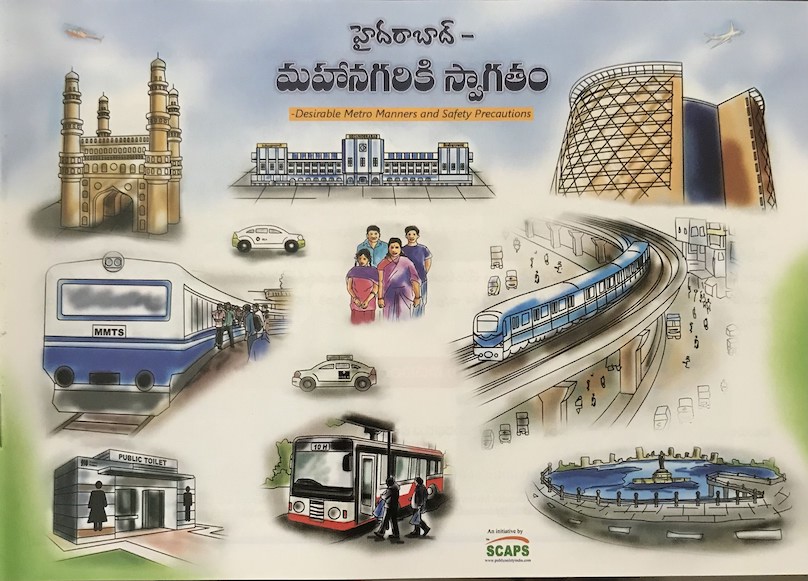
Mahanagari Ki Swagatham
Download e-book
Physical copies: Rs. 100 per copy plus postage. Special pricing available for schools and NGOs.
E-mail: publicsafetyindia@gmail.com
Safe School
There are stringent laws on school building construction and maintenance. Beyond those rules, common-sense steps and a sincere approach from school management can make any campus a safer place for children.
For school managements & principals
- Plan the total student intake against classroom area — follow the prescribed ratio.
- Provide two exit/entry points on every floor.
- Fit staircases with hand-railings.
- Ensure natural light and ventilation in every classroom.
- Secure chemistry labs and kitchens with appropriate fire extinguishers; train staff and children above 13 to use them.
- Educate children on safety preparedness and emergency evacuation.
- Instruct sports and games coaches to strictly enforce safety rules for each activity.
- School transport vehicles must follow 100% Road Transport Authority rules; arrange periodic third-party checks.
- Maintain clean toilet facilities for boys and girls with standard washroom signage.
- Keep safe drinking water within easy reach.
- Ensure electrical distribution boxes and terminals are properly installed with child-protection gadgets.
- For educational tours, partner with authorised travel agents and follow Department of Education guidelines.
- Share complete pre-trip information — including risk factors — with students and parents.
- Mark "Exit" signage at appropriate places across the campus.
- Never lock staircases or emergency exits.
- Stock first-aid kits on every floor.
- Display emergency phone numbers and contact persons on the notice board.
- Keep playgrounds under continuous supervision by a sports coach or security guard.
For parents — choosing a school
- Give priority to a school close to your residence (mandatory practice in some countries).
- Visit the school with your child to check the environment against the safety points above.
- Verify official recognition — State or Central Government approval is a must.
- Confirm the school bus complies with all Road Transport Authority regulations.
- Note the driver and bus operator's mobile numbers.
- Interact with drivers; remind them of safe driving and orderliness.
- Teach your child to follow the attendant or driver's instructions during the ride.
- Request a copy of the school's emergency plan; keep one copy at home and another at work.
School bus — for children
- While at the bus stop, wait in a safe place.
- Never speak to strangers at the bus stop.
- Never accept goodies from strangers.
- Enter the bus in single file, holding the handrail.
- Once boarded, go directly to a seat.
- Stay seated, facing forward, the entire ride.
- Never throw things inside the bus or out of the windows.
- Don't play with the emergency exits.
- Don't sneak out through the bus window.
- Don't distract the driver.
- If you need to cross the road after getting off, wait for the bus to leave first.
On campus
- Play games and sports with the required safety accessories — follow your coach's instructions strictly.
- Prevent ragging. Respond calmly and firmly if you encounter it.
- Don't show off expensive belongings.
- Avoid carrying large amounts of money.
- If a schoolmate hits you, tell a teacher or supervisor immediately.
- Violence never solves anything — avoid fighting.
Safe Girl
Safety for girls in metropolitan cities is a matter of grave concern. Many young women migrate to big cities for work and study, adjusting from traditional environments to fast-paced urban life — making awareness of public safety precautions essential to a happy and trouble-free Metro life.
Everyday precautions
- When leaving home, take a moment to notice if any stranger is loitering suspiciously.
- Watch for vehicles parking abruptly — note number plates and colour.
- Walk boldly and look confident when on the move.
- Don't hesitate to call your local women's helpline or police control room to report harassment.
- Never wear headphones while walking.
- Always use familiar and busy roads to reach office or home.
- Let someone know when you leave and arrive at work or study places.
- When boarding public transport, pay attention and avoid conversation with strangers.
- If shared auto or taxi is unavoidable, check that the driver is in uniform and behaves properly. Note the vehicle number and save it to your mail.
- Never take a "lift" from strangers on a two- or four-wheeler.
- Know the rules of the Road Transport Authority when using public transport.
- Maintain orderliness in public life.
- Avoid dressing that draws undue attention; follow local norms where sensible.
- While walking, keep to the right side of the road, facing oncoming traffic.
- Mobile apps and social media are useful — but stay "net-secured": apply private settings carefully.
- Keep your phone charged with sufficient battery backup.
On a day out
- In any new place — workplace, mall, cinema, function hall or park — quickly identify the emergency exit, ladies' washroom and security personnel.
- If you're subjected to eve-teasing or any disturbing act, inform the police even if you don't want to register a case. Your information helps police vigilance.
- Make social vigilance part of your Metro life — it builds confidence and alertness.
- Being alert is not the same as being covert. Foreseeing danger is wisdom, not paranoia.
For parents of girls aged 4 – 12
Protect them from child abuse. Educate them about the personal aspects of growing up. Explain what's right, what's wrong, what's good and what's bad. Teach them the ten rules below — and make them a daily habit.
The ten important rules
- I will not allow a "bad touch".
- I will not hear a "bad word".
- I will not speak bad words to a stranger.
- I will speak about anything bad or good only with my mom or a lady doctor.
- I will not see a "bad picture".
- I will not follow any stranger to a lonely place.
- I will not allow any stranger to give me a hug.
- I will not allow any stranger to kiss me.
- I will not allow any stranger to hold me.
- I will scream to raise an alarm when in trouble.
Public Places — Cinemas, Malls & Crowds
Despite Central, State and local safety laws, many cinema halls, malls and commercial establishments are not adequately prepared for fires, earthquakes or man-made incidents. A few simple precautions can significantly reduce the impact of a disaster — especially for women's personal safety in crowded public spaces.
In cinemas, malls & crowds
- Pickpocketing is common in crowded places — secure your wallet and avoid wearing expensive jewellery.
- Maintain space in the crowd; don't push or crush against others.
- Avoid cinema halls or malls that lack adequate fire and life-safety systems.
- Before settling in a cinema or auditorium seat, check underneath. Report any suspicious object to security.
- Identify the Exit and Emergency Exit routes of any public place you visit.
Avoiding a stampede
- Most stampede casualties happen because of unnecessary panic in the crowd.
- If you notice a panic situation, stay calm — observe and confirm the cause before reacting.
- Know your exit routes. Don't run — walk briskly.
- Don't stop at an exit point. Keep it clear for others.
- Avoid shoulder-to-shoulder movement in queues.